
About Me
Friday, February 5, 2010
Google-inspired designer collections
Each year, Vogue and the Council of Fashion Designers of America (CFDA) sponsor a Fashion Fund to support emerging designers. In 2009, each participating designer was asked to create a one-of-a-kind item inspired by Google in some way — whether through our logo's colors, technology or our commitment to equal access to information. Last October, we transformed 10 of the finalists’ designs into iGoogle Artists themes. While we loved seeing fashion meet iGoogle, we wanted to see these pieces in person — and wear them! Today, we’re debuting three of our favorite designs from this challenge. These three featured designers have customized their original designs for a broader audience, and we’re making them available to the public to purchase for a limited time. Check out this page to learn more about the items, the designers and how they were inspired by Google.


Wednesday, February 3, 2010
Doodle 4 Google — Tell us what you would do if you could do anything...
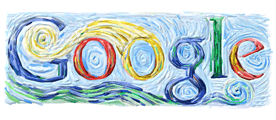
Today, we're excited to announce our third annual Doodle 4 Google contest in the U.S. Google doodles, created by our talented team of doodlers, have helped us celebrate events and anniversaries from Van Gogh's birthday to Valentine's Day. And since 2008, Doodle 4 Google has given K-12 kids the opportunity to create their own logo and have it displayed on the Google homepage for hundreds of millions of users to enjoy for a day.
In addition to the winner's art appearing on Google.com on May 27, 2010, they'll also receive a $15,000 college scholarship, a laptop computer and a $25,000 technology grant for their school.
 This year's theme is "If I Could Do Anything, I Would..." and it's all about pushing the limits, dreaming big, and seeing what you can accomplish in life. When coming up with inspiration for this year's contest, we turned to some of our very own Googlers, including Ed Lu, a former astronaut.
Ed typifies this year's theme in action, and shares an inspiring anecdote:
On my first mission STS-84, one of my crewmates and I were having dinner aboard the Space Shuttle Atlantis. After all our work for the day was done, we decided to eat "upside down" on the ceiling, gazing out at the Earth moving by below our feet. As we flew around the Earth, watching the continents go by, my crewmate remarked how amazingly large the Earth really is. But at that same time, it also felt small to us. There we were, flying at 18,000 miles per hour around the Earth in a machine built by humans, with a crew made up of astronauts from all over the world. Both of our observations were true at the same time. The world is indeed a big place with many challenges. But by using science, technology and the power of people working together, nearly anything is possible.
So dream big! If you could do anything, what would you do?
For even more inspiration, you can see last year's winner, Christin Engelberth, a sixth grader at Bernard Harris Middle School in San Antonio, Texas. She titled her doodle "A New Beginning" to express her wish that "out of the current crisis, discoveries will be found to help the Earth prosper once more."
We're happy to let you know that this year, we've also assembled a panel of well-known "Expert Jurors," including creative directors, cartoonists and famous animators ranging from Sesame Workshop to Pixar Animation Studios. Our Expert Jurors will help us narrow down the cream of the crop to 40 regional finalists, who will come to the Google office in New York City on May 26, 2010. For the second year, we'll also be partnering with the Smithsonian's Cooper-Hewitt, National Design Museum, where the top 40 regional finalists will get to have their artwork displayed in a national exhibit. And for the first time this year, we'll give out eight Technology Booster awards to schools that submit maximum number of doodles per school by March 10th and have students in our 400 State Finalists.
Please visit the official competition website for a full listing of all contest rules and requirements. Only students from registered schools can enter, so be sure your school is registered by March 17, 2010. All doodles must be submitted by March 31, 2010.
We hope you're as excited about this year's contest as we are. Good luck!

In addition to the winner's art appearing on Google.com on May 27, 2010, they'll also receive a $15,000 college scholarship, a laptop computer and a $25,000 technology grant for their school.
 This year's theme is "If I Could Do Anything, I Would..." and it's all about pushing the limits, dreaming big, and seeing what you can accomplish in life. When coming up with inspiration for this year's contest, we turned to some of our very own Googlers, including Ed Lu, a former astronaut.
Ed typifies this year's theme in action, and shares an inspiring anecdote:
On my first mission STS-84, one of my crewmates and I were having dinner aboard the Space Shuttle Atlantis. After all our work for the day was done, we decided to eat "upside down" on the ceiling, gazing out at the Earth moving by below our feet. As we flew around the Earth, watching the continents go by, my crewmate remarked how amazingly large the Earth really is. But at that same time, it also felt small to us. There we were, flying at 18,000 miles per hour around the Earth in a machine built by humans, with a crew made up of astronauts from all over the world. Both of our observations were true at the same time. The world is indeed a big place with many challenges. But by using science, technology and the power of people working together, nearly anything is possible.
So dream big! If you could do anything, what would you do?
For even more inspiration, you can see last year's winner, Christin Engelberth, a sixth grader at Bernard Harris Middle School in San Antonio, Texas. She titled her doodle "A New Beginning" to express her wish that "out of the current crisis, discoveries will be found to help the Earth prosper once more."
We're happy to let you know that this year, we've also assembled a panel of well-known "Expert Jurors," including creative directors, cartoonists and famous animators ranging from Sesame Workshop to Pixar Animation Studios. Our Expert Jurors will help us narrow down the cream of the crop to 40 regional finalists, who will come to the Google office in New York City on May 26, 2010. For the second year, we'll also be partnering with the Smithsonian's Cooper-Hewitt, National Design Museum, where the top 40 regional finalists will get to have their artwork displayed in a national exhibit. And for the first time this year, we'll give out eight Technology Booster awards to schools that submit maximum number of doodles per school by March 10th and have students in our 400 State Finalists.
Please visit the official competition website for a full listing of all contest rules and requirements. Only students from registered schools can enter, so be sure your school is registered by March 17, 2010. All doodles must be submitted by March 31, 2010.
We hope you're as excited about this year's contest as we are. Good luck!
Tuesday, February 2, 2010
A recent improvement for Arabic searches
This post is the latest in an ongoing series about how we harness the data we collect to improve our products and services for our users. - Ed.
We've learned that when performing a search on Google, people sometimes forget to separate words with spaces. Moreover, people often mistakenly repeat a letter within a single word. For instance, when writing the query [amazingly beautiful poem], you might write it as [amazingly beautiifullpoem].
These types of errors are much more common in languages like Arabic, where most of the letters are cursive. That means that the shapes of the letters change, based on the position of the letter in the word (initial, middle, final or isolated). Moreover, some Arabic letters are considered word breaks, meaning that the following letter must be in an "initial" shape. In other words, if the last letter of one word is a word break, the following word may not be separated with a space.
For example, the queries [وزارةالتعليم] and [وزارة التعليم] have an identical meaning (Ministry of Education) and they're both written in a common form for Arabic documents. But they have different, albeit correct, formats — the first query is written as a single word, while the second is written as two. Google needs to understand that while they're written differently, they mean the same thing and should yield the exact same search results. In this example, both queries were written correctly, just in different formats. But sometimes people just make errors — like repeating the same letter twice. For example, you might write [راائعة الجماال], repeating the letter "ا" twice in both query words. In this case the correct spelling should be [رائعة الجمال]. It's important that Google search recognizes your query — despite spelling errors.
To address issues like this, we recently developed a search ranking improvement that targets certain Arabic queries. Our algorithm employs rules of Arabic spelling and grammar along with signals from historical search data to decide when to leave out spaces between words or when to remove unnecessarily repeated letters. Now, when you type a query leaving out spaces or repeating a letter, we'll return better results based not only on what you typed, but also on what our algorithm understands is the "correct" query. For example, here's what happens when you type [قصيدة راائعةالجماال] ([amazingly beautiful poem] in Arabic) with repeated letters and dropped spaces between words.

As you can see, the Google results contain the corrected query, the terms قصيدة رائعة الجمال, in bold.
For most people, this might seem like a small enhancement. But for us, it’s a big change. Our tests show we've improved search for 10% of Arabic language queries. Which, when you think about it, is a lot of people.
We've learned that when performing a search on Google, people sometimes forget to separate words with spaces. Moreover, people often mistakenly repeat a letter within a single word. For instance, when writing the query [amazingly beautiful poem], you might write it as [amazingly beautiifullpoem].
These types of errors are much more common in languages like Arabic, where most of the letters are cursive. That means that the shapes of the letters change, based on the position of the letter in the word (initial, middle, final or isolated). Moreover, some Arabic letters are considered word breaks, meaning that the following letter must be in an "initial" shape. In other words, if the last letter of one word is a word break, the following word may not be separated with a space.
For example, the queries [وزارةالتعليم] and [وزارة التعليم] have an identical meaning (Ministry of Education) and they're both written in a common form for Arabic documents. But they have different, albeit correct, formats — the first query is written as a single word, while the second is written as two. Google needs to understand that while they're written differently, they mean the same thing and should yield the exact same search results. In this example, both queries were written correctly, just in different formats. But sometimes people just make errors — like repeating the same letter twice. For example, you might write [راائعة الجماال], repeating the letter "ا" twice in both query words. In this case the correct spelling should be [رائعة الجمال]. It's important that Google search recognizes your query — despite spelling errors.
To address issues like this, we recently developed a search ranking improvement that targets certain Arabic queries. Our algorithm employs rules of Arabic spelling and grammar along with signals from historical search data to decide when to leave out spaces between words or when to remove unnecessarily repeated letters. Now, when you type a query leaving out spaces or repeating a letter, we'll return better results based not only on what you typed, but also on what our algorithm understands is the "correct" query. For example, here's what happens when you type [قصيدة راائعةالجماال] ([amazingly beautiful poem] in Arabic) with repeated letters and dropped spaces between words.

As you can see, the Google results contain the corrected query, the terms قصيدة رائعة الجمال, in bold.
For most people, this might seem like a small enhancement. But for us, it’s a big change. Our tests show we've improved search for 10% of Arabic language queries. Which, when you think about it, is a lot of people.
Announcing Google's Focused Research Awards
(Cross-posted with the Google Research Blog)
Today, we're announcing the first-ever round of Google Focused Research Awards — funding research in areas of study that are of key interest to Google as well as the research community. These awards, totaling $5.7 million, cover four areas: machine learning, the use of mobile phones as data collection devices for public health and environment monitoring, energy efficiency in computing, and privacy. These are all areas in which Google is already deeply invested, and yet there is a long way to go. We're excited to see what these projects contribute to the body of research in these important areas.
These unrestricted grants are for two to three years, and the recipients will have the advantage of access to Google tools, technologies and expertise. We've given awards to 12 projects led by 31 professors at 10 universities:
Machine Learning: William Cohen, Christos Faloutsos, Garth Gibson and Tom Mitchell, Carnegie Mellon University
Use of mobile phones as data collection devices for public health and environment monitoring: Gaetano Borriello, University of Washington and Deborah Estrin, UCLA
Energy efficiency in computing:
- Ricardo Bianchini, Rutgers, Fred Chong, UC Santa Barbara, Thomas F. Wenisch, University of Michigan and Sudhanva Gurumurthi, University of Virginia
- Christos Kozyrakis, Mark Horowitz, Benjamin Lee, Nick McKeown and Mendel Rosenblum, Stanford
- David G. Andersen and Mor. Harchol-Balter, Carnegie Mellon University
- Tajana Simunic Rosing, Steven Swanson and Amin Vahdat, UCSD
- Thomas F. Wenisch, Trevor Mudge, David Blaauw and Dennis Sylvester, University of Michigan
- Margaret Martonosi, Jennifer Rexford, Michael Freedman and Mung Chiang, Princeton
- Ed Felten, Princeton
- Lorrie Cranor, Alessandro Acquisti and Norman Sadeh, Carnegie Mellon University
- Ryan Calo, Stanford CIS
- Andy Hopper, Cambridge University Computing Laboratory
Update at 1:13 PM: Added Allesandro Acquisti and Norman Sadeh to the list of PIs on the CMU privacy project.
Monday, February 1, 2010
Wrapping up our Free Holiday WiFi program
In November, we officially launched our Free Holiday WiFi gift. 54 airports, one airline and many millions of connected WiFi users later, our two-month Free Holiday WiFi sponsorship ended on January 15. We're happy to have made this year's holiday travel season just a bit easier for the millions of people who logged on and connected at our participating airports and on Virgin America flights.
Though some airports will no longer have free WiFi, we're excited that Burbank, Seattle and most recently, Boston airports have all decided to offer free WiFi all year.
In the spirit of the season, passengers connecting to the networks donated over $250,000 to Engineers Without Borders, One Economy Corporation and Climate Savers Computing Initiative. With Google's matching donation, the three charities received over $500,000 in total.
Finally, Edward Doan of Austin, Texas won the grand prize of ten Virgin America tickets, a Motorola Droid from Verizon Wireless and a Canon SX200 digital camera. You can view a complete list of winners on the contest site.
Though some airports will no longer have free WiFi, we're excited that Burbank, Seattle and most recently, Boston airports have all decided to offer free WiFi all year.
In the spirit of the season, passengers connecting to the networks donated over $250,000 to Engineers Without Borders, One Economy Corporation and Climate Savers Computing Initiative. With Google's matching donation, the three charities received over $500,000 in total.
Finally, Edward Doan of Austin, Texas won the grand prize of ten Virgin America tickets, a Motorola Droid from Verizon Wireless and a Canon SX200 digital camera. You can view a complete list of winners on the contest site.
Subscribe to:
Posts (Atom)
